
Can Exercise Reduce Cancer?
August 06 2025
Every decade or so, a study comes along that shifts your understanding about a topic. This is one such study. So whether you exercise or not, keep reading:
Why did they do the study?

- Cause & effect: Colon cancer is the 3rd most common cancer affecting both men and women. Although we have observational studies showing exercise can ‘reduce’ cancer and improve survival, we don’t have any randomized controlled trials that show the same. If you have been following me, you very well know that only randomized controlled studies can show cause and effect. Observational studies tend to fool us. So the million dollar question remains - can exercise really reduce cancer??
So what did they do?
- Population: 889 patients with an average age of around 61 years from 55 study centers in 6 countries with high-risk stage II or stage III colon cancer, who had undergone treatment (surgery and chemotherapy), were randomized into two groups as shown below:
- Intervention group: Half of the participants were placed in a structured exercise program for 3 years involving aerobic exercise only. This included supervised sessions every two weeks or monthly for 3 years and had to exercise at moderate to vigorous intensity. For example, 45 to 60 minutes of brisk walking 3 or 4 times per week.
- Comparator group: This group received only health-education materials for 3 years.
- Outcome: The major outcome was disease-free survival (occurrence of either recurrent colon cancer, a new primary cancer, a second primary cancer, or death). They also looked at survival or how long participants lived.
What were the results?
- Disease-free survival: After around 5 years, the disease-free survival was 28% better for the exercise group than the non-exercise group. Absolute risk showed a 6.4% improvement.
- Survival: Did they live longer? Yes! Survival showed a 27% improvement after 8 years, which further strengthens the results for disease-free survival. Absolute risk showed a 7.1% improvement.
My comments:
Compared to cancer drugs : That’s great, but how does this improvement compare to cancer drugs? A similar study was presented at the recent American Society of Clinical Oncology (ASCO), the world’s largest cancer conference in 2025, showing that chemotherapy combined with immunotherapy (atezolizumab) in Stage III colon cancer led to a 9% increase in disease-free survival at 3 years. The results were so compelling that many advocated for immediate implementation. If you scroll back, the impact of exercise is just as compelling (6% in 5 years)! In fact, the improvement with exercise is similar to that of many FDA approved cancer drug treatments.
Other benefits : Even if exercise didn’t really help with cancer recurrence or mortality, it is still incredibly valuable considering the non-cancer benefits of improving physical function and quality of life in cancer patients. Remember, we have no drug that can improve or prevent the decline in function that comes with cancer, cancer treatment, or any other disease. And let’s not forget the countless benefits of exercise (psychological, cognitive, metabolic, cardiovascular, and musculoskeletal).
Missing headlines: With all these benefits from exercise, yet most major news channels either didn’t report this or buried it somewhere in the health section. This should be front-page news. I believe this is due to a lack of understanding of research designs. We’ve been reading and hearing that exercise “reduces” cancer, but until this study, all the evidence came from observational studies. So this study felt like another “exercise is good for you” study. Instead, what we should have always said is that exercise is “associated/linked” with a lower risk of cancer, which clearly conveys the uncertainty and reflects the limitations of observational studies.
Mechanisms of exercise: As expected, the study also saw an improvement in the 6-minute walk test and cardiorespiratory fitness. But guess what? The improvement in disease-free survival from exercise was primarily driven by reductions in cancers as shown in the mage below. Please don’t forget that if a new drug shows even a 1% reduction in cancer recurrence, it would be instantly approved! Also, the improvement in survival was largely due to improved cancer outcomes: 33 died in the exercise group while 56 in the control group died from cancer.
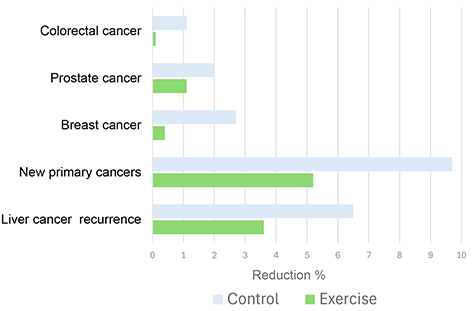
So how does exercise reduce cancer? From the paper: increased fluid shear stress, enhanced immune surveillance, reduced inflammation, improved insulin sensitivity, effects on growth factors, and altered microenvironment of major sites of metastases. I would also add that there could be multiple mechanisms that are completely unknown to us. Contrary to what your favorite health guru or your colorful physiology textbooks say, the body is way too complex for us to predict accurately, especially in disease. And this is exactly why we run scientific trials!
Study quality - any good?: Study quality is low risk of bias or high quality. Briefly, they used central randomization, which is the gold standard, intention-to-treat analysis, dropout is less than 5%, and unbiased and pre-registered primary outcomes of cancer & death.
Limitations: The cost per patient for 48 sessions with an exercise consultant for 3 years was between $3k and $5k. For perspective, the average cancer drug costs around $10-12k per month, has severe side effects, and no other ancillary benefits. When people are left to make an informed decision, they look at benefits, risks, and other alternatives - not just the cost itself. The adherence was low, but this is typical for long-term exercise trials. Yet it’s remarkable that the results are what they are even with low adherence.
More questions: What about other cancers? What about preventing cancers in the first place rather than reducing recurrence? I am pretty positive that these effects would be similar for other cancers too, and exercise probably has a strong effect on prevention as well. But that would need more research. If not for this study, we would be endlessly debating this question like they do on news channels and podcasts with no certainty. This is an excellent example of how a field can ONLY improve with scientific research.
Conclusion
- In colon cancer patients after chemotherapy, exercise can prevent cancer recurrence and help you live longer.
- Exercise should be included as a standard of care for cancer treatments.
- Did you exercise today?


